
Client Identity Verification
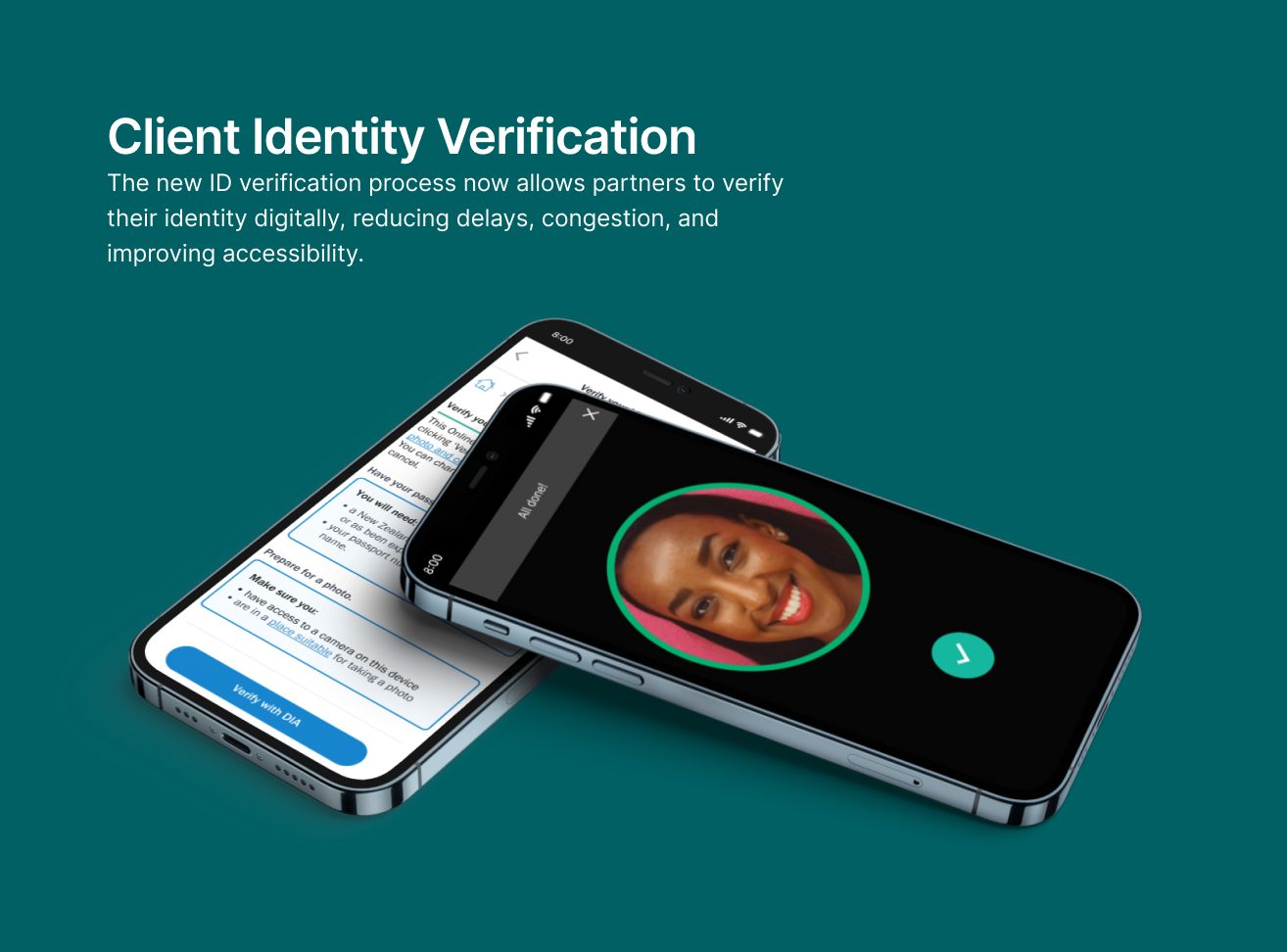


Client Identity Verification – Partner
- Category: Government Web application / Self-service Digital Platform
- Client: Ministry of Social Development
- Project date: March - November 2023
- Project URL: my.msd.govt.nz
- Mobile Relevance & Platform Strategy
Note: The actual feature is not publicly accessible, as it is part of a client-based experience. Please refer to the wireframes and final design shown.
This feature was designed with mobile-first usability and accessibility in mind. Layouts were validated at key breakpoints - primarily for smartphone screen sizes - to ensure clarity, tap-friendly interaction, and WCAG compliance. UI components scale seamlessly across devices, supporting simplified navigation and reduced cognitive load.
Role & Responsibilities
- Role: Senior UX/UI Designer
- Key contributions: UX/UI Design, Ideation & Concept Development, Accessibility & Usability, Portfolio & Product team engagement
Overview
Client identity is a complex organisational challenge involving verification, authentication, and lifecycle management. As part of the ongoing Client Identity Verification (CIV) Epic, I supported the Income Portfolio team in exploring Phase 2 enhancements to the digital identity experience within MyMSD. This phase focused on enabling partners of primary clients to verify their identity online — a critical improvement following the initial rollout in November.
In Phase 1, only primary applicants could use DIA’s Identity Check to verify their identity digitally. Partners, however, were excluded and required to present physical documents at Service Centres. This gap created delays, added pressure to front-of-house staff, and disrupted the application process for financial assistance.
Empathise
Research and Discovery
- Collaborated with the Income Portfolio team, case managers, and business units
- Gathered feedback from clients, partners, and frontline staff
- Identified pain points: long queues, inconsistent digital parity, and stress on staff
- Reviewed CMS/DIA integration rules and existing sighted ID logic
Objective
The goal of Phase 2 was to extend DIA Identity Check functionality to partners, allowing them to verify their identity independently and digitally. This would reduce in‑person visits, streamline application processing, and improve the overall user experience for both clients and MSD staff.
Define
Problem Definition
Through synthesizing our user research, we identified a critical, human-centered problem. The exclusion of partners from the digital verification flow meant they had to attend Service Centres in person, often waiting in long queues and taking time off work. This not only caused frustration but also delayed the processing of financial assistance applications, putting clients at a disadvantage. The inconsistency between the digital experience of primary clients and their partners undermined the overall efficiency and fairness of the system.
Point of View (POV) Statement
Partners of primary clients need a digital way to verify their identity because the existing process is inconvenient, causes stress, and delays access to financial assistance.
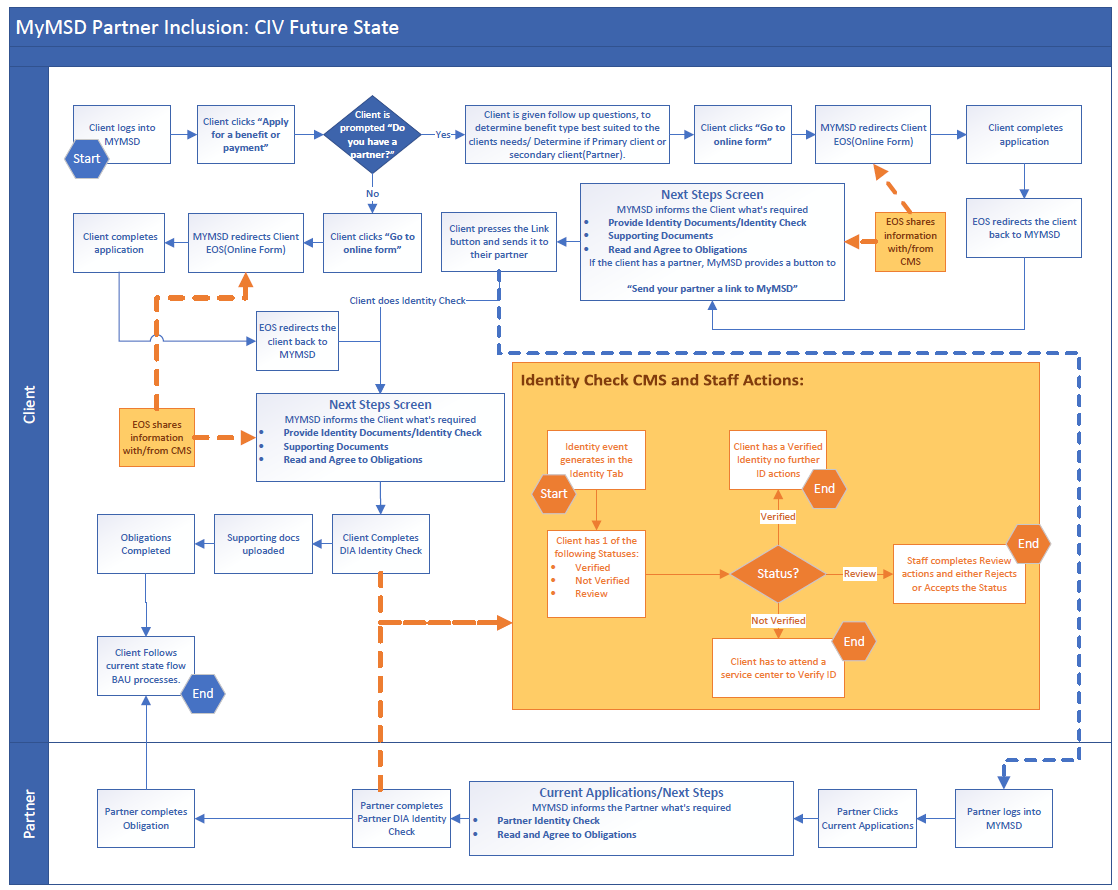
Future state flow for partner identity verification in MyMSD.
System Constraints and User Needs
Working closely with the Income Portfolio team and business units, I synthesized the technical, operational, and user experience implications of extending digital verification to partners.
System constraints:- Partner verification must follow primary client rules
- DIA status must be integrated into CMS
- Business processes and upload flows need to be updated
- Clients expect parity in digital access
- Partners need clarity and secure handling of data
- Case managers require efficiency without adding stress to front‑of‑house operations
Ideate
Reframing the Problem (How Might We Questions)
After synthesizing research and empathy findings, it became clear that the raw problem of partners being excluded from digital verification needed to be reframed into a design challenge. This ensured the focus shifted from describing pain points to identifying an actionable opportunity for design. We used the following "How Might We" (HMW) questions to guide our brainstorming:
How might we enable partners to complete identity verification digitally—without compromising security, fairness, or operational feasibility?
How might we make the online verification process for partners as efficient and seamless as it is for primary clients?
How might we reduce pressure on frontline staff by enabling partners to self-serve their verification?
Concept Exploration
Following the discovery phase, I contributed to a collaborative ideation process with the UX team to explore how the partner verification experience could be introduced with clarity, simplicity, and parity. Our goal was to extend a secure, trusted flow without overwhelming users or disrupting existing MyMSD patterns.
Together, we explored multiple concept directions through sketching, whiteboarding, and flow mapping. These included entry points for partners, messaging strategies to build trust, and visual indicators for verification status. We focused on guiding users through the DIA Identity Check with minimal friction, while ensuring accessibility and cultural neutrality.
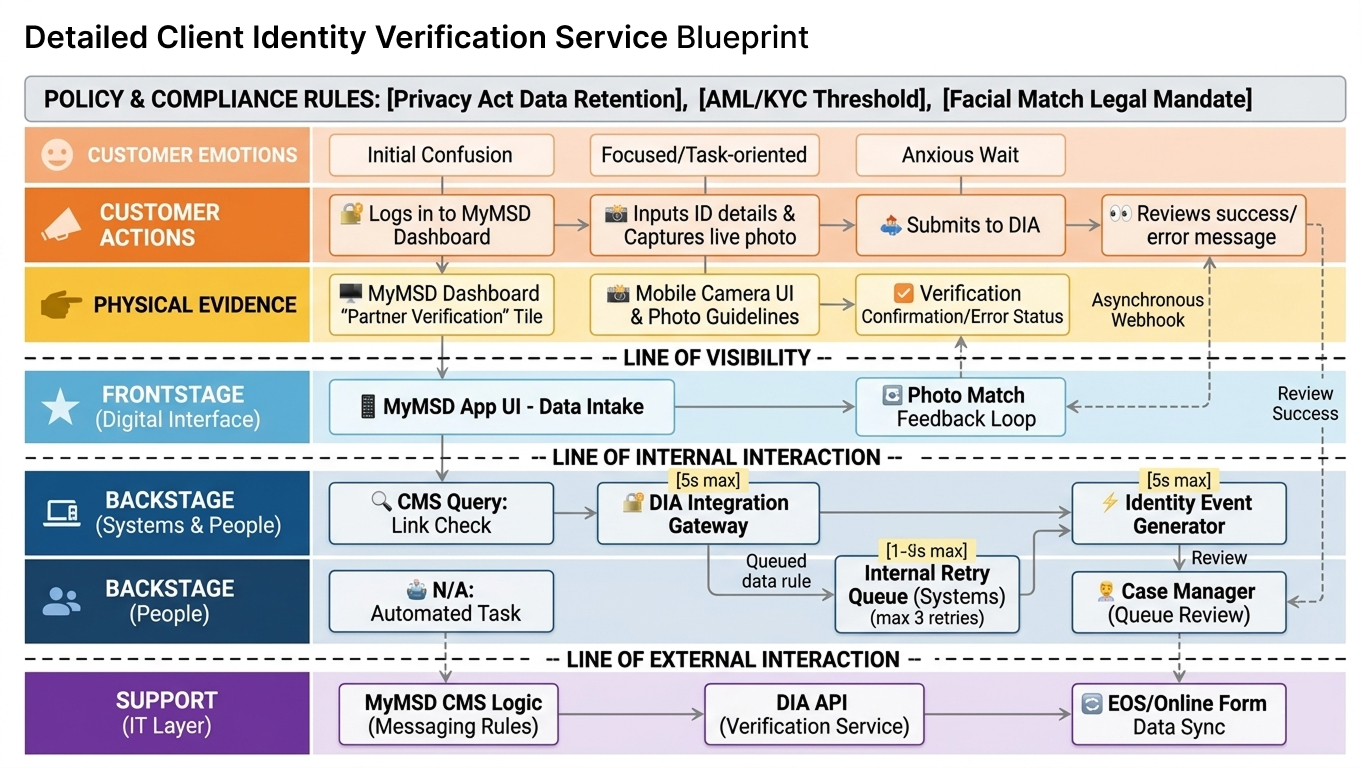
Concept directions explored:
- Dashboard tile: A partner-specific dashboard tile to mirror the primary client experience
- Checklist interface: A checklist-style interface to prepare users for verification
- Conditional messaging: Based on CMS and DIA status
- Simplified onboarding: A simplified onboarding flow that explained the process and built confidence
These ideas were sketched, whiteboarded, and mapped, then reviewed internally and with stakeholders to validate logic, usability, and integration points with CMS and DIA systems.
Prototype
I supported early‑stage UX exploration to define how the partner experience could mirror the primary client journey while addressing unique needs. This involved mapping end‑to‑end flows, identifying key decision points, and designing UI components that guided partners through the verification process. The interface needed to be intuitive, culturally neutral, and aligned with MyMSD’s existing design patterns.
Iterative mapping guided the design process from early wireframes to final validation, shaping the partner verification flow with precision. Each layout decision was aligned with CMS logic, DIA integration, and accessibility standards, while stakeholder priorities were clarified and delivery risks reduced through continuous validation at every decision point.
Low-fidelity
I created quick wireframes to explore layout options and map the journey from entry point to confirmation. These grayscale flows informed design decisions, focusing on clarity, clear language, and minimal friction, and allowed rapid iteration before committing to high‑fidelity design. However, they are not shown here, though they played a critical role in shaping the final solution.
High‑fidelity
Building on these explorations, I developed high‑fidelity prototypes in Figma to test content hierarchy, responsiveness, and alignment with MSD’s accessibility standards. Both wireframes and prototypes evolved through multiple review cycles, incorporating stakeholder feedback and technical constraints to refine layout, messaging, and accessibility support.
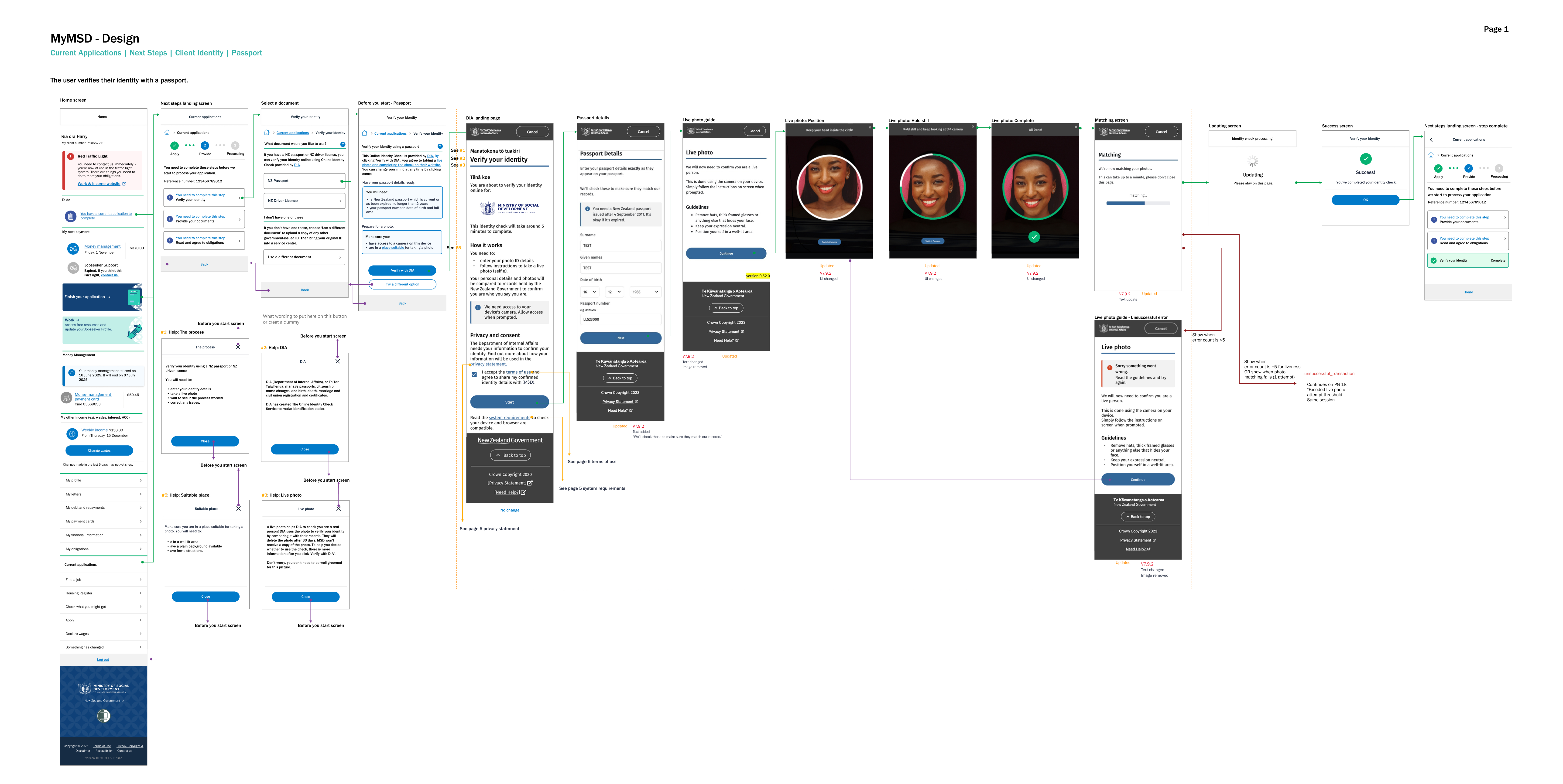 Verification using passport wires
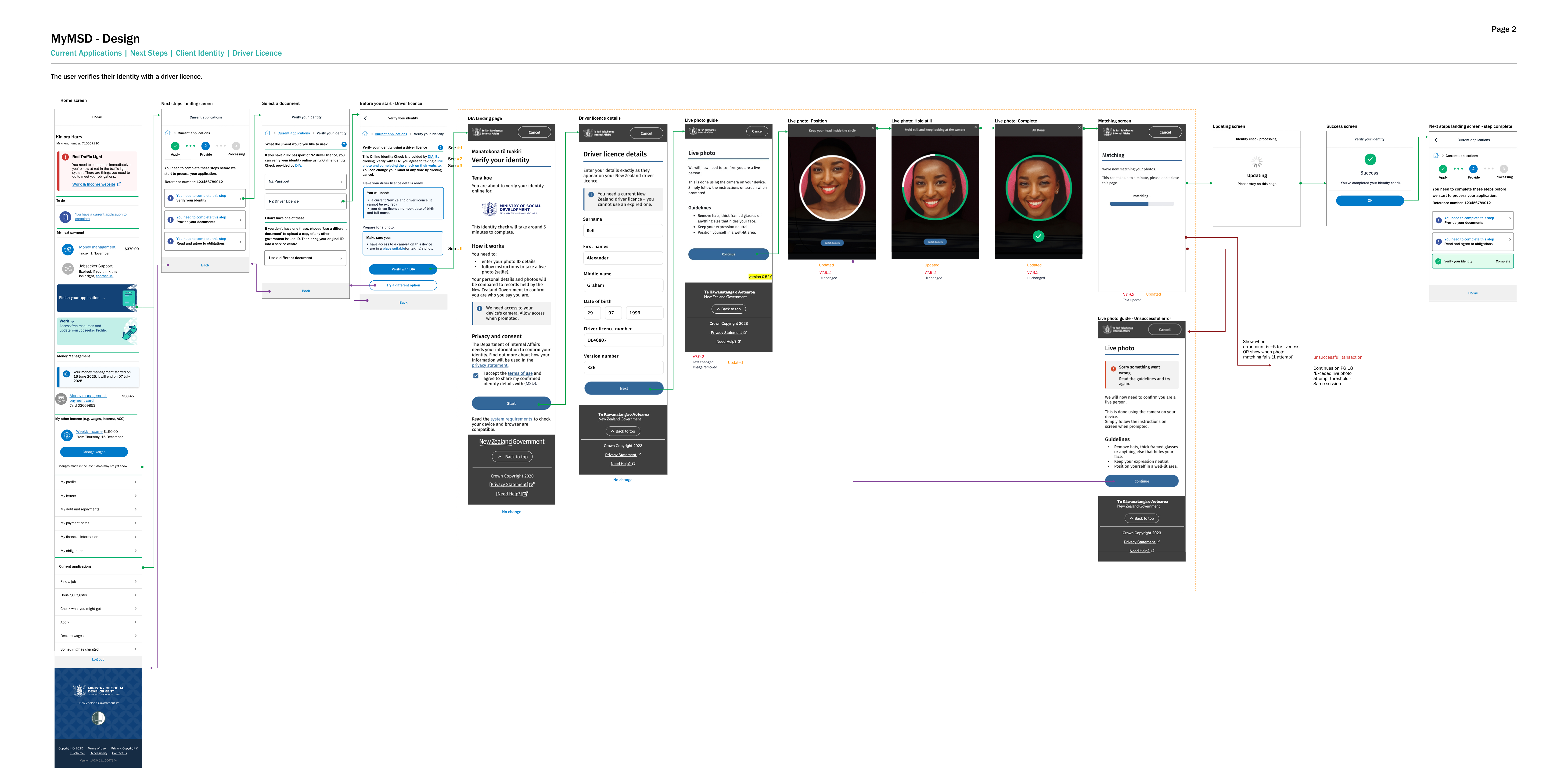 Verification using driver's licence wires
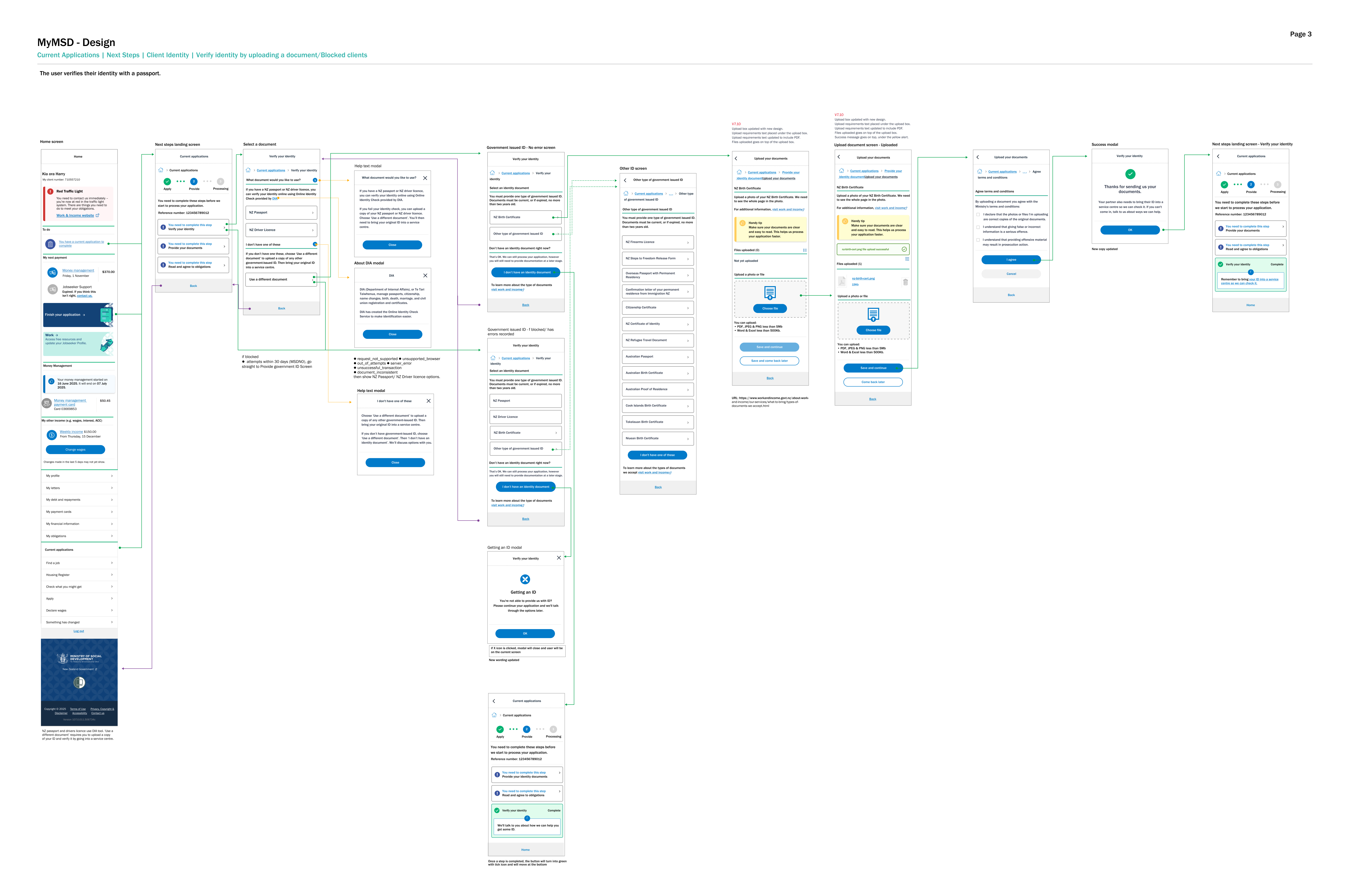
Testing
Validate
To align design intent with operational, technical, and accessibility standards, I facilitated a cross-functional Design Lab session that mirrored agile sprint ceremonies. This checkpoint de-risked delivery and validated feasibility across CMS integration, WCAG compliance, and partner-specific workflows.
These sessions served as iterative checkpoints, enabling early course correction and continuous refinement across feasibility, accessibility, and frontline workflows.
Stakeholder Alignment
- Digital Product Owner and Product Manager — to validate scope, sequencing, and release feasibility
- Front-End Developer — to confirm technical feasibility, CMS integration, and DIA Identity Check flow
- Accessibility Team — to ensure WCAG compliance, screen reader compatibility, and inclusive interaction patterns
- Comms and Content Team — to refine messaging tone, cultural neutrality, and plain language guidance
- Portfolio Team and Case Manager — to align with frontline workflows and reduce manual verification overhead
Validation Goals
- Confirm end-to-end partner flow from entry to verification outcome
- Test clarity of onboarding content, checklist structure, and status indicatorss
- Identify risks in data handling, conditional messaging, and CMS integration
- Ensure accessibility and cultural neutrality across devices and user contexts
Outcomes
- Refined onboarding screen to clarify DIA Identity Check purpose and security
- Adjusted checklist language and visual hierarchy for scanability and comprehension
- Validated conditional logic for success/failure messaging based on DIA response
- Confirmed CMS handoffs and partner-specific status tracking
- Strengthened accessibility support for keyboard navigation, screen readers, and mobile responsiveness
Final Design
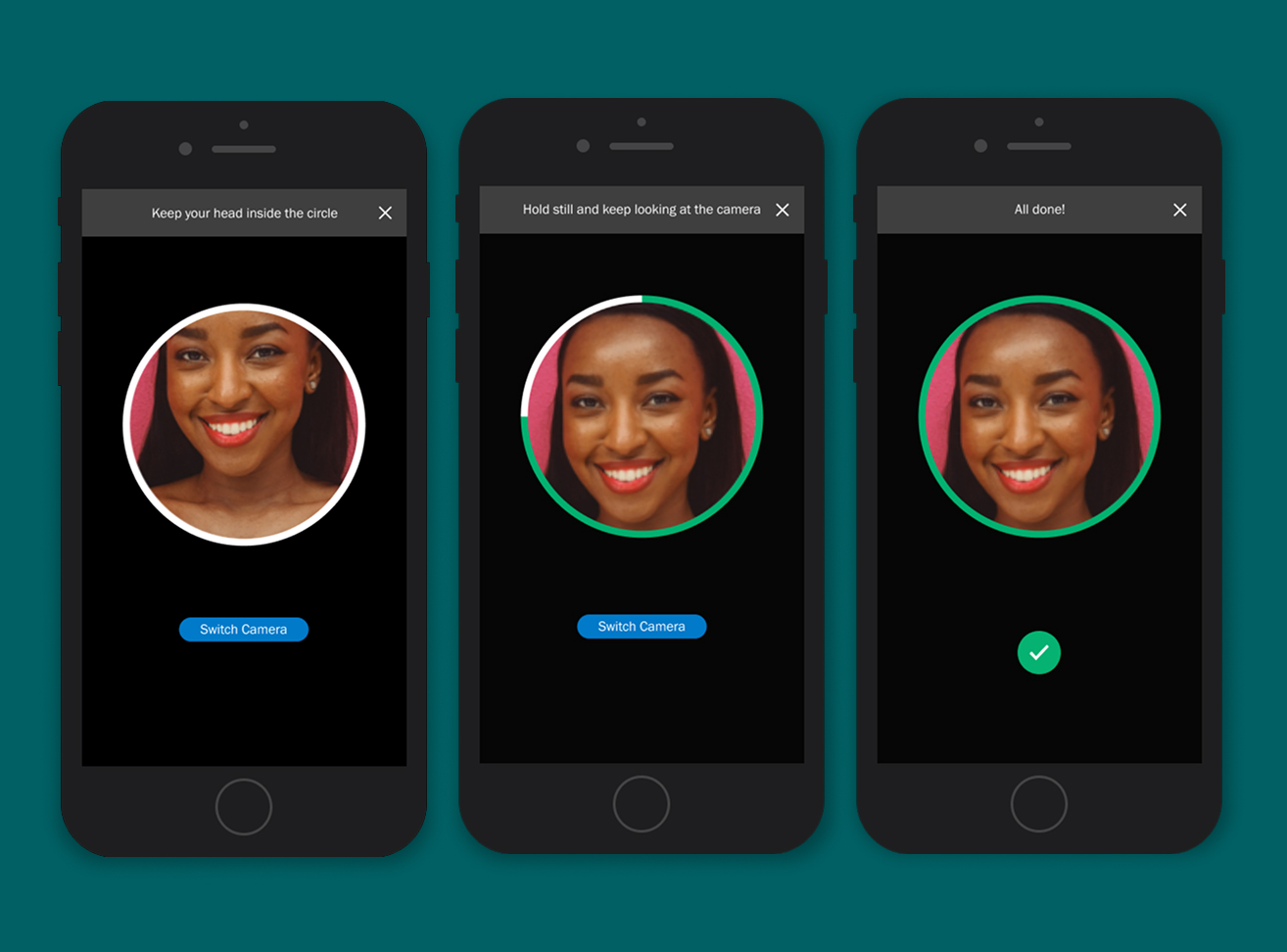
The final design integrates seamlessly with MyMSD’s existing UI, extending the digital identity experience to partners with clarity and consistency. It introduces a clean, accessible interface that guides partners through the DIA Identity Check process using familiar patterns and culturally neutral visuals.
Key design elements include:
- Dashboard tile:A dedicated dashboard tile for partner identity verification, styled to match MyMSD’s visual language
- Checklist:A step-by-step checklist outlining required documents and next actions
- Status indicators: That reflect verification progress and outcomes
- Conditional messaging: that adapts based on CMS data and DIA response
- Responsive layouts: Optimized for mobile and desktop use
The design prioritizes simplicity, trust, and parity with the primary client experience. It ensures that partners feel informed and empowered, while case managers gain reliable visibility into verification status — reducing manual follow-ups and front-of-house congestion.
Implementation Scope
To support delivery and reduce fraud risk, the implementation needed to:
- Allow partners to complete DIA Identity Check independently
- Integrate DIA status into CMS with clear visibility for case managers
- Align partner ID logic with existing rules for primary clients
- Minimize unnecessary interactions with clients and partners
- Update all relevant business processes and documentation
Impact & Outcomes
By enabling partners to verify their identity digitally, we achieved significant outcomes for both users and the organization:
- Improved equity: The digital solution for partners created parity with the primary client experience, ensuring fair access
- Faster processing: Delays in financial assistance processing were reduced due to streamlined verification
- Increased operational efficiency: The change eased congestion at Service Centres and lowered operational strain on front-of-house staff
- Enhanced trust: Trust in MSD’s digital services was strengthened through a more reliable and user-friendly experience
- Platform for growth: This work laid the foundation for future enhancements to identity lifecycle management and partner engagement